You ran a draft through a humanizer, it came back sounding looser, and you published it. Then a client asked where the line about "smart decisions" came from. You never wrote it. The humanizer did.
The ranking
| Rank | Tool | Verdict | Free limit | Monthly price |
|---|---|---|---|---|
| 1 | RemoveAISlop | Cleared every tracked tell, nothing invented, every edit explained | Five drafts a day, 1,200 words each | $9.99 (€8.90) |
| 2 | Grammarly AI Humanizer | Natural rewrite, no facts changed, contrast line left in | 1,500 words a run | $12 (€10.70), billed yearly only |
| 3 | Humanize AI | Highlights its edits, added a promise and a new stock opener | Free to use | $9.99 (€8.90) |
| 4 | WriteHuman | Added a claim and a grammar error | Three runs a month, 250 words each | $20 (€17.80) |
| 5 | Undetectable AI | Softened two figures, added a claim, grew the text by half | 250-word trial | $9.99 (€8.90) |
| 6 | StealthGPT | Invented three product benefits, kept the contrast line | 100 words | $29.99 (€26.70) |
Euro figures converted at the rate on the published date and rounded. Check each vendor's pricing page for the current charge in your currency.
The order follows one rule. A humanizer that changes what your draft says loses to one that does not, however good its sentences sound. Among the tools that kept the meaning, the cleaner rewrite wins.
Why a humanizer can hurt a draft it was meant to fix
A humanizer exists to change wording. The risk is that it changes more than wording.
Most of these tools are built on a language model, and a model asked to make text "sound human" will happily add a reason, soften a number or invent a benefit, because fluent padding is what it produces best. On a school essay that is an annoyance. On client copy with revenue figures and launch dates, it is a correction email.
Detector scores do not catch this. Liang and colleagues00130-7) found in Patterns in 2023 that seven AI detectors misclassified 61.3% of 91 essays written by non-native English speakers as machine-written. A tool tuned to move that number is optimising for an instrument that cannot tell a careful human from a chatbot. Accuracy is a better test.
The test paragraph, and what each tool did to it
Every tool got the same 73-word product paragraph about a fictional analytics company, written the way a chatbot writes: a grand opening line, a contrast built on "not just a tool", and four words our catalogue lists as heavily overused by models. It also held eight facts a reader could check: the company name, its home city, its founding year, two customer counts, a time saving, a release month and a product integration.
We counted which facts survived, read every output for claims the original never made, noted the length of each rewrite, and ran every result through RemoveAISlop's free checker. The original scored 47% for AI phrasing.
| Tool | Facts kept, of 8 | Claims added or changed | Words, from 73 | AI phrasing score, from 47% |
|---|---|---|---|---|
| RemoveAISlop | 8 | None | 55 | 0% |
| Grammarly AI Humanizer | 8 | None | 84 | 27% |
| Humanize AI | 8 | Two | 82 | 21% |
| WriteHuman | 8 | Two | 81 | 27% |
| Undetectable AI | 8, two softened | Three | 110 | 0% |
| StealthGPT | 8 | Three | 114 | 0% |
No tool dropped a figure outright. The failure is subtler: a new claim inside a sentence that still sounds right, or "4,200" quietly becoming "over 4,200", which is exactly what a quick read misses.
The phrasing score has a blind spot worth knowing. Undetectable AI and StealthGPT both scored 0%, yet each kept a "more than just a tool, it's a partner" line, one split with a dash and the other with extra words in the middle, in shapes our catalogue does not catch yet. A low score means fewer known tells, not a better rewrite, which is why the ranking puts meaning first.
The six humanizers, ranked
1. RemoveAISlop, the only rewrite that changed nothing it should not
RemoveAISlop rewrites with fixed rules rather than a language model, so it cannot invent a sentence it was never given. On the test it cut the grand opening line, turned the not-just-a-tool contrast into a plain statement, and folded the empty closing line into "Northwind improves every client conversation". The paragraph shrank to 55 words, and our checker scored it 0%.
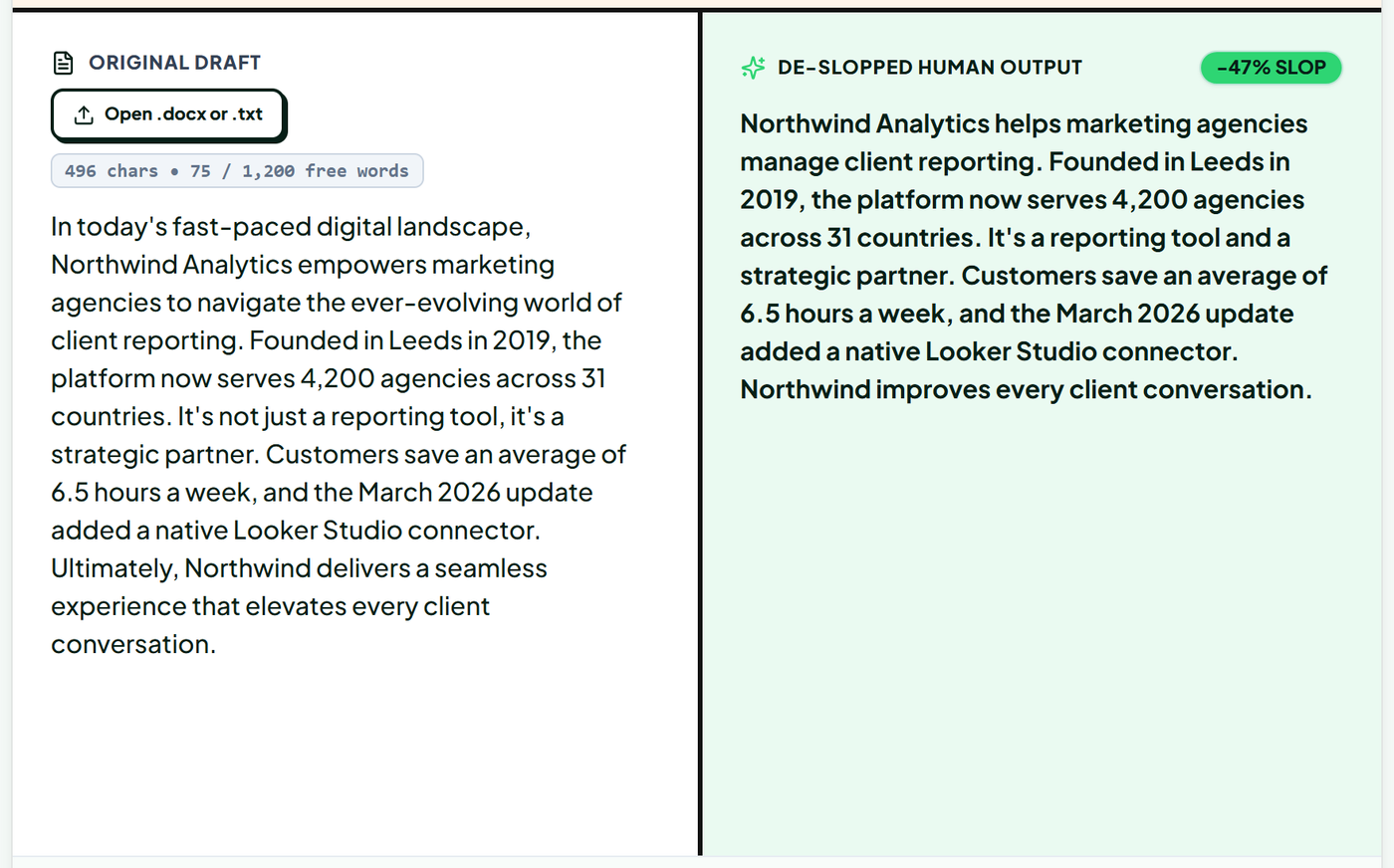
All eight facts stayed exactly as written, down to the half hour in the time saving. That is by design: every edit is checked before it is kept, and if a number, name or quotation would go missing, the sentence stays as you wrote it. The studio lists every change with the rule that made it, so you can see why each word moved, and the free AI humanizer checks any draft for the tells first.
It has limits. Rules only change what they recognise, so a stock phrase our catalogue does not list yet will pass through, and three-item lists are left alone rather than risk dropping an item. If you want lighter edits, the Light touch setting keeps sentence structure as written. The free plan gives five drafts a day without an account, each up to 1,200 words, and Creator removes the limit for $9.99 a month (about €8.90).
2. Grammarly AI Humanizer, the best of the model-based tools
Grammarly's humanizer is free, needs no account, and accepts 1,500 words at a time. It produced the most natural paragraph of the model-based tools and changed no facts.
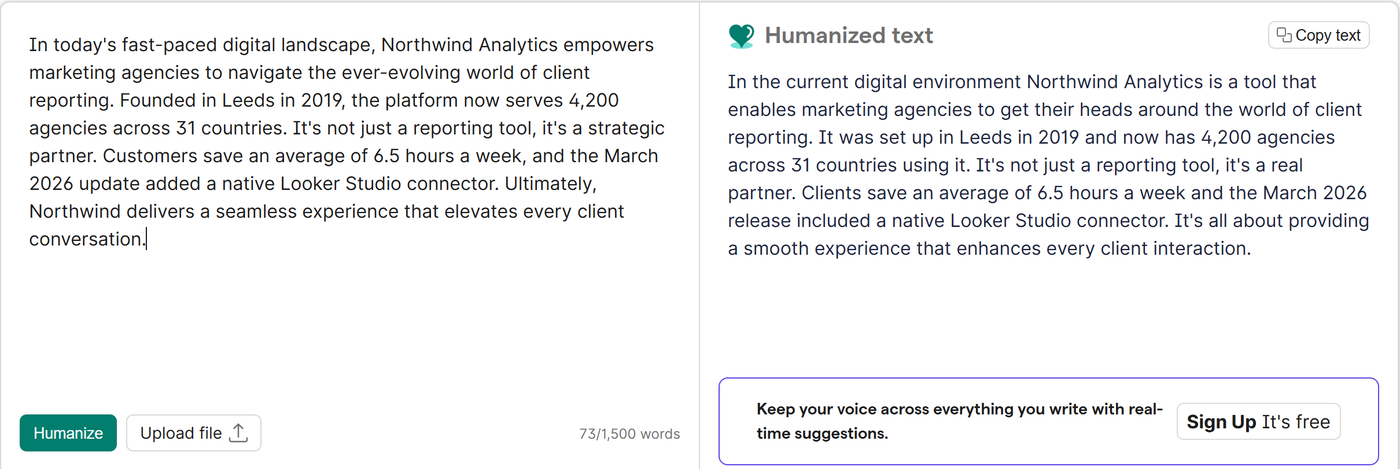
It still left fingerprints. The opener became "In the current digital environment" with the comma after it missing, the contrast line survived as "it's a real partner", and a filler phrase appeared at the end. Read it once before you publish.
We ran Grammarly's rewrite through RemoveAISlop's checker to see what was left. It flagged the partner contrast and flat sentence rhythm, scored the rewrite 27% for AI phrasing against 47% for the original, and found no spelling or grammar errors.
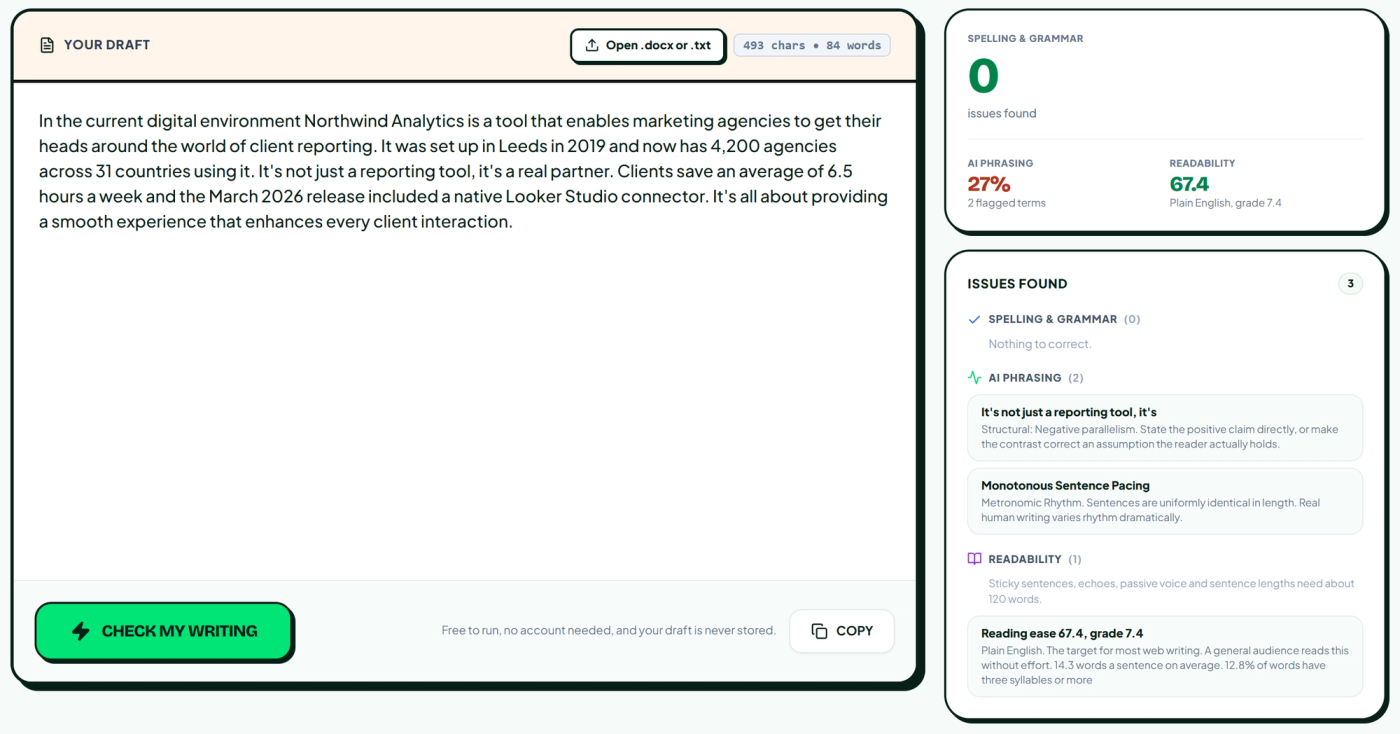
Our checker did not flag the missing comma, because it leaves comma placement alone, and it missed the new opener. Grammarly Pro is $12 a month (about €10.70), billed yearly, the only price on its plans page, and our Grammarly alternatives comparison covers the rest of that subscription.
3. Humanize AI, for a free run with every change highlighted
Humanize AI is free and highlights every change it makes, which makes it easy to review. It kept all eight facts, though it reordered the release month into "the 2026 March update".
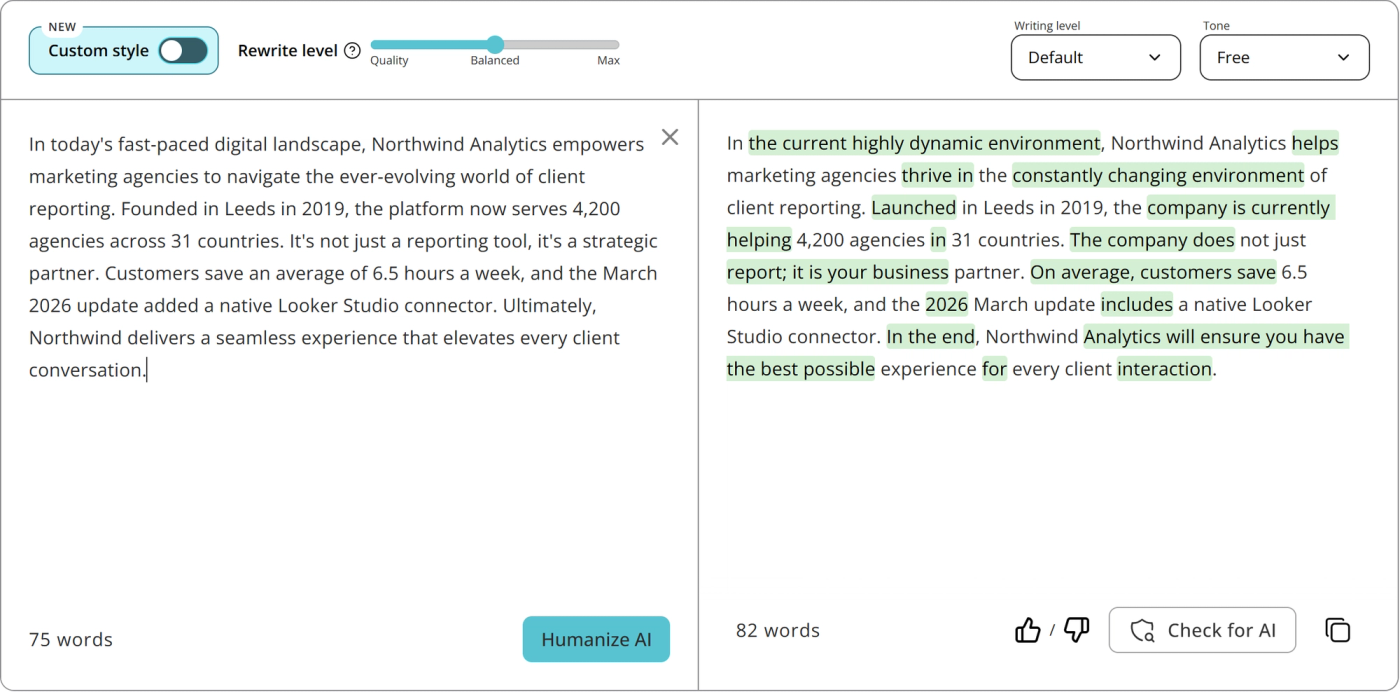
It also added things. A new opener, "In the current highly dynamic environment", replaced the old stock line with another one, and the closing sentence now promises Northwind "will ensure you have the best possible experience", which the original never claimed. The contrast survived as "does not just report; it is your business partner". Lite costs $9.99 monthly, roughly €8.90, and covers 10,000 words.
4. WriteHuman, for short pieces on a small free allowance
WriteHuman kept every figure but dropped "native" from the connector. It added a closing promise to help clients "in being successful", which is both a new claim and a grammar error, then stamped its own output "100% Human".

The free tier allows three runs a month at up to 250 words each. Basic is $20 a month (about €17.80) for 80 runs of up to 600 words.
5. Undetectable AI, for heavy rewrites you will check line by line
Undetectable AI rewrote almost every clause and stretched the text to 110 words. It turned "4,200 agencies" into "over 4,200" and "an average of 6.5 hours" into "around 6.5 hours", dropped "native" from the connector, and told us the platform "helps agencies make the most of their time", which the original never said.
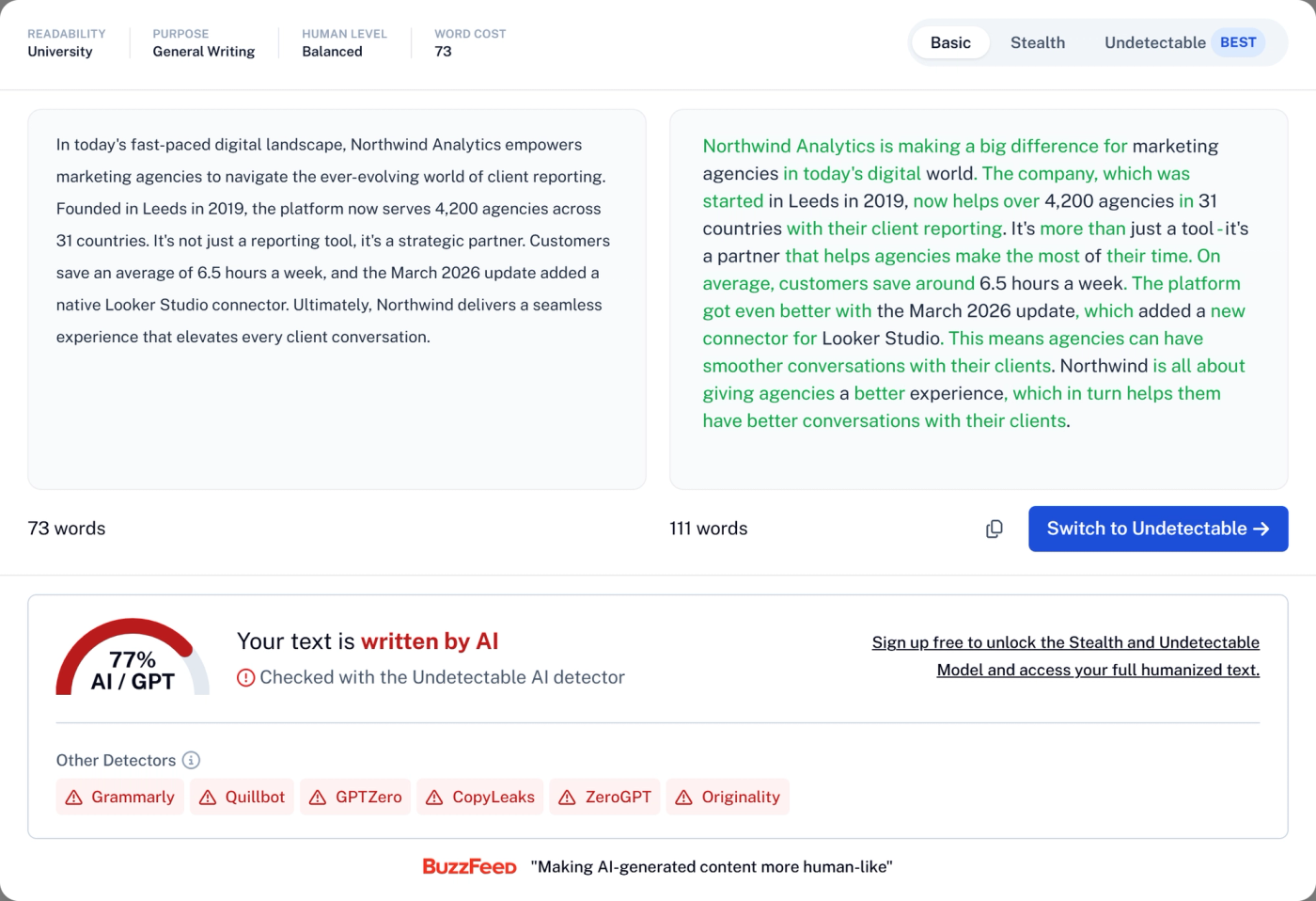
Its own built-in detector rated that output 77% AI, so the free mode does not pass its maker's check. Paid plans start at $9.99 (around €8.90) per month for 10,000 words.
6. StealthGPT, last for the benefits it invents
StealthGPT kept every figure and added the most of its own. Customers now "benefit from its ease of use", the March update arrived "amongst many other new features", and the platform "makes client reporting effortless and sets agencies up for success". None of that was in the draft, and the contrast held on as "more than just a reporting tool".
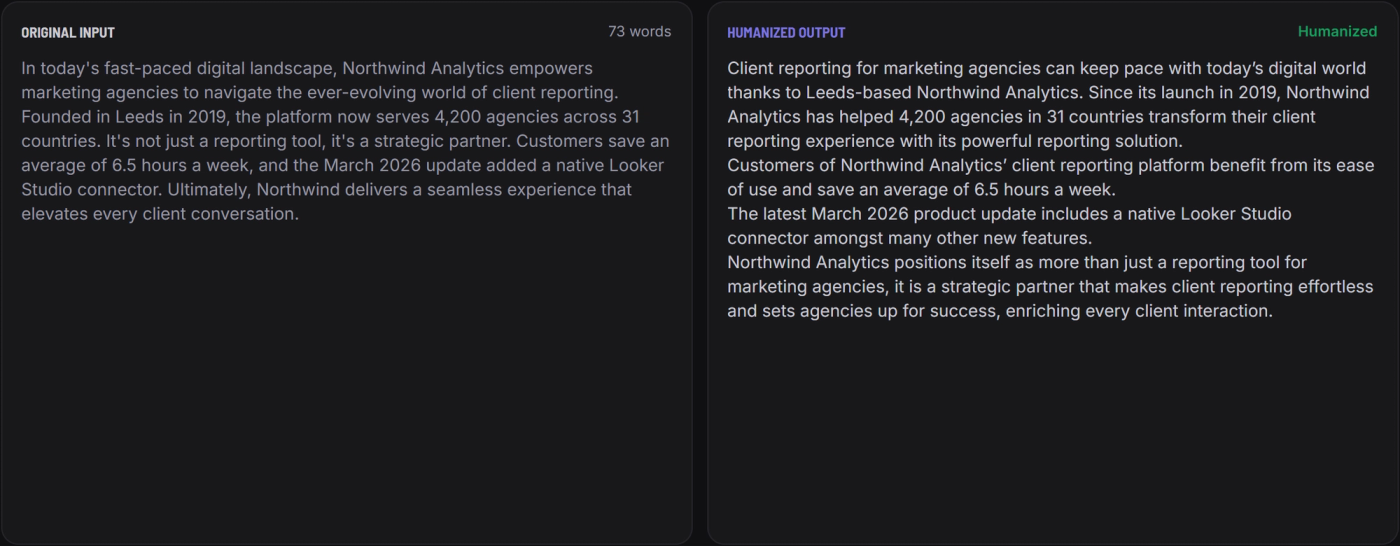
The output ran to 114 words, and the free version stops at 100 words of input. Pro costs $29.99 a month (about €26.70) for 50,000 words, after a $1 three-day trial.
Check any humanizer's output in five minutes
The test above takes five minutes on your own draft, and it catches the failures a read-through misses.
First, list the facts. Before you paste anything in, write down every number, name, date and product the draft contains. Our test paragraph had eight. A typical 800-word post has fifteen to twenty.
Then search the output for each one. Use find, not your eyes. A softened figure ("over 4,200" for "4,200") reads naturally and slips past a skim.
Read every adjective the tool added. "Powerful", "effortless" and "best possible" are claims. If the original did not make them, delete them.
Compare the word counts. A rewrite that grew by half has added something. Find it.
Finally, run the result through a check for AI phrasing, because a rewrite can trade one stock phrase for another. Grammarly, Humanize AI and Undetectable AI all produced new openers the original did not have.
What no humanizer can promise
No tool on this list can guarantee a result on someone else's detector, ours included. Detector vendors retrain without notice, and a score is a probability rather than proof, which is why AI detectors flag human writing so often.
What a humanizer can do is remove the phrasing readers notice, the vocabulary models overuse and the formulaic openers, and leave your facts alone. Our list of words AI overuses is a fast way to learn which ones cost you most.
This ranking comes from one 73-word paragraph, run on each tool's free version. Paid modes may rewrite differently, and every model-based tool gives a different answer on a second run.
Do this before your next humanized draft goes out
Take the last piece you ran through a humanizer and open the version you published. Write down every number and name in your original draft, then search the published copy for each one.
If any came back changed, or a sentence appeared that you never wrote, that is the tool you should stop trusting with client work. If none did, run the same check on your next draft anyway, because a model-based tool will not give you the same rewrite twice.